
Creating brave spaces: how female-only environments reshape water sport participation
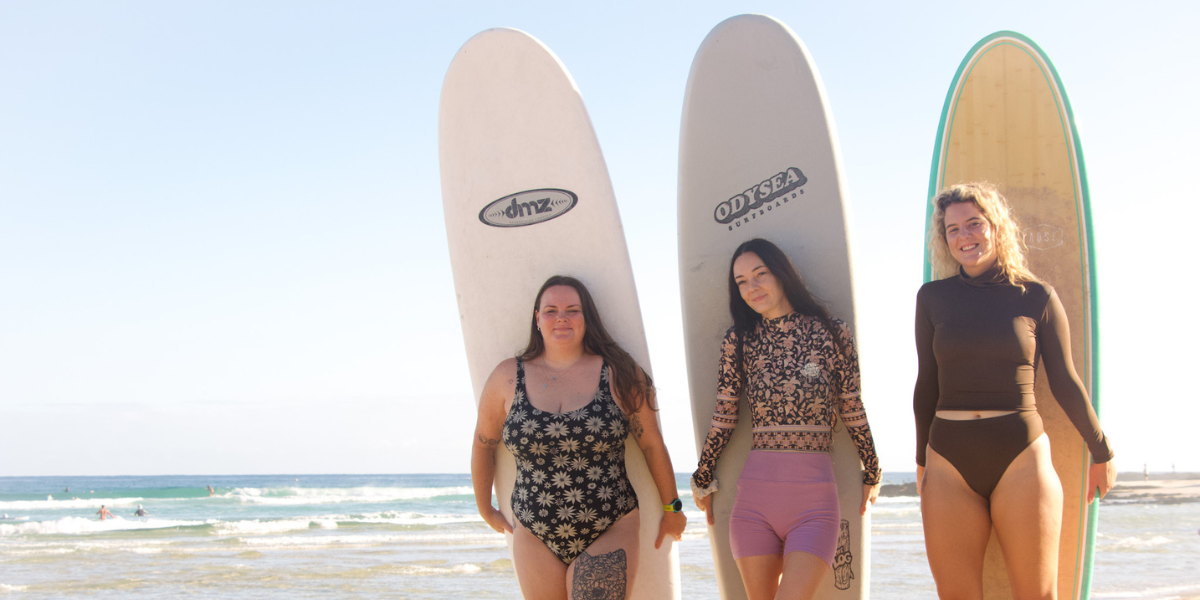
Surfing can look like freedom from the shoreline. Then you paddle out and meet the other reality: crowded line-ups, unwritten rules, and the feeling that everyone can see you learning in real time.
For many women, the intimidation isn’t about “being tough enough.” It’s about trying to learn a complex, public, male-dominated sport while also managing the social pressure that comes with being watched, judged, and compared.
Female-only environments don’t magically remove fear. But they do something more powerful: they turn fear into something workable. They create brave spaces—places where you can be nervous, try anyway, laugh, ask “basic” questions, and come back next week.
Why surfing intimidation hits differently in mixed-gender spaces
Research on women’s surfing experiences consistently points to barriers beyond waves and weather: confidence, safety, social norms, and male-dominated culture in the line-up. (js.sagamorepub.com)
In mixed-gender settings, many beginners don’t just worry about falling. They worry about what falling means socially.
That can include:
Fear of being judged as incompetent (especially when you’re the only woman out)
Fear of taking up space “wrong” (dropping in, sitting in the wrong spot, not knowing etiquette)
Fear of male aggression or being wave-snatched in the pack (mdhs.unimelb.edu.au)
Fear of being watched as a body, not as an athlete (a pressure that shows up across sport and exercise contexts) (pubmed.ncbi.nlm.nih.gov)
Those fears push behaviour in a predictable direction: people play small, take fewer attempts, ask fewer questions, and leave earlier. And in surfing, fewer attempts means slower progression—which reinforces the original belief: “Maybe I’m just not cut out for this.”
What women-only spaces change (psychologically and socially)
Women-only surf environments work because they alter the social conditions of learning.
They reduce the “performance” layer—where you’re not only trying to surf, you’re trying to look like someone who should already be able to surf.
1. Fewer comparison traps, more experimentation
In a women-only line-up, the dominant comparison target changes.
Instead of measuring yourself against the loudest, most experienced guy taking the most waves, you’re surrounded by people who often share similar goals: learning the basics, building ocean awareness, and getting comfortable taking up space.
That shift matters because skill development depends on repetition and risk-taking: paddling for more waves, popping up even when it’s messy, and staying out long enough to get feedback—exactly why a women-only progression weekend can be such a confidence accelerator (more reps, more support, less social penalty for being new).
Evidence from single-sex physical education settings suggests girls can show higher engagement (including higher exertion in some contexts) when the environment is structured as single-sex rather than coeducational. (sciendo.com)
2. Psychological safety: asking the “embarrassing” questions
Beginner surfing is full of questions you might not want to ask in front of strangers:
Where do I sit without getting in the way?
Why can’t I paddle straight?
What if I panic when I get held under?
How do I pee in a wetsuit?
In women-only spaces, those questions become normal. And that’s not fluffy—it’s skill retention. If you’re brand new, reading common beginner questions answered before you paddle out can be the difference between spiralling and showing up anyway.
When learners feel safe admitting what they don’t know, they get clearer coaching, practice the right things, and avoid the shame spiral that makes people quit. This is how confidence actually grows: not by never being scared, but by being supported while you do it anyway.
3. Body image becomes discussable, not isolating
Surfing is a sport where your body is visible, functional, and (often) compared—especially in beach culture.
Across adolescent sport research, teasing and body image concerns are linked with lower participation for girls, including teasing that can come from both same-sex and opposite-sex peers. (pubmed.ncbi.nlm.nih.gov)
Female-only environments make it easier to talk about the real stuff:
Wetsuits that don’t fit like they were designed for you
Feeling exposed walking down the beach
The mental load of being “seen”
The fear of not looking like a surfer
When those conversations happen out loud, they stop being personal defects and start being shared experiences — which is a major step toward long-term participation. Spaces that intentionally pair surf progression with nervous-system support—like a surf plus mindfulness retreat—can make those conversations easier to have (and easier to carry back into the water).
Sisterhood is not a bonus. It’s the retention strategy.
A key finding from women’s surfing stories is how supportive community helps women push through stigma, sexism, motherhood demands, and confidence dips—especially in male-dominated regions. (mdhs.unimelb.edu.au)
This is where women-only spaces quietly outperform “just learn with your mates”: You don’t only gain a skill. You gain a crew.
That crew becomes:
Your accountability (you show up because someone’s waiting)
Your safety net (someone notices if you’re overwhelmed)
Your social proof (other beginners progressing makes your goals feel realistic)
Your identity shift (“I’m becoming a surfer” starts to feel true)
In women-only surfing communities like Club Shakas Communities, the philosophy is simple: ‘Fun First, Surf Second’ because joy is what keeps people coming back long enough to actually progress. And on trips with Club Shakas like an all-inclusive Lombok retreat, that “crew effect” is baked in—shared meals, shared laughs, shared courage, day after day.
Mixed-gender vs women-only: what changes in the learning environment
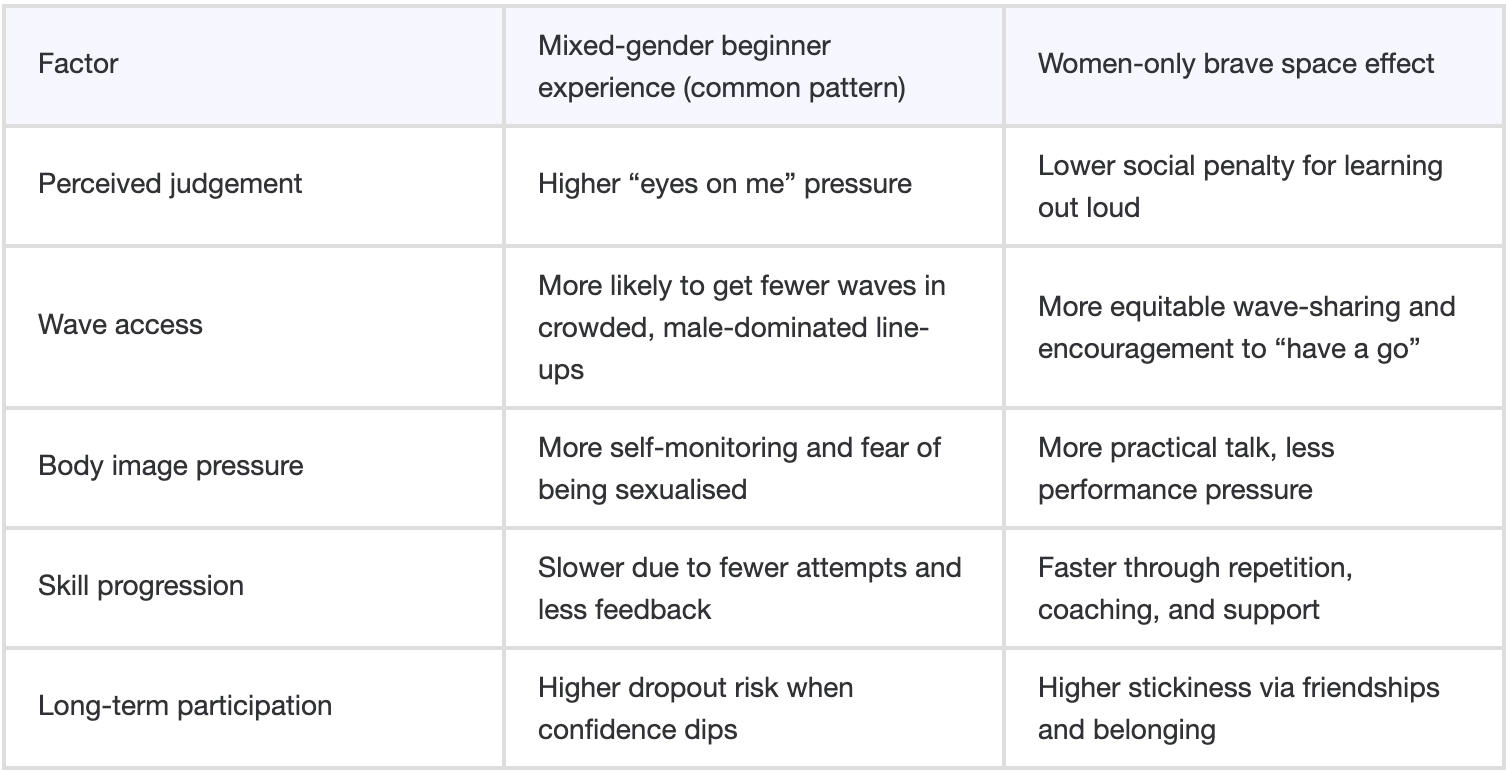
A women-only surf retreat or program isn’t only “a trip.” Done well, it’s a structured confidence accelerator: coaching, repetition, and community wrapped into one.
Club Shakas builds retreats around beginner-to-intermediate women—creating experiences designed by women, for women, with locations like Lombok, Byron Bay, Trigg, and Nusa Lembongan. If an approachable first step helps, a Byron Bay surf retreat is a great example of that structure in action.
The format matters: you’re not just dropped into a chaotic line-up and told to be brave. You’re guided, you debrief, you laugh, you recover, and you try again tomorrow. And if you’re someone who needs a future date to commit, even a simple step like join the waitlist can create momentum and accountability by contacting us.
The bigger impact: changing who gets to belong in the ocean
Surfing culture is changing, but the numbers and stories still show a participation gap and persistent barriers for women. (uts.edu.au)
Female-only spaces don’t separate women because they can’t handle mixed settings. They exist because many mixed settings still aren’t designed for women to learn safely, confidently, and joyfully.
When women-only communities create brave spaces, they don’t just teach pop-ups.
They reshape identity:
I’m allowed to be here.
I’m allowed to learn.
I’m allowed to take up space in the ocean.
If your bravery starts with asking questions privately first, you can always book a discovery call—no pressure, just support.
